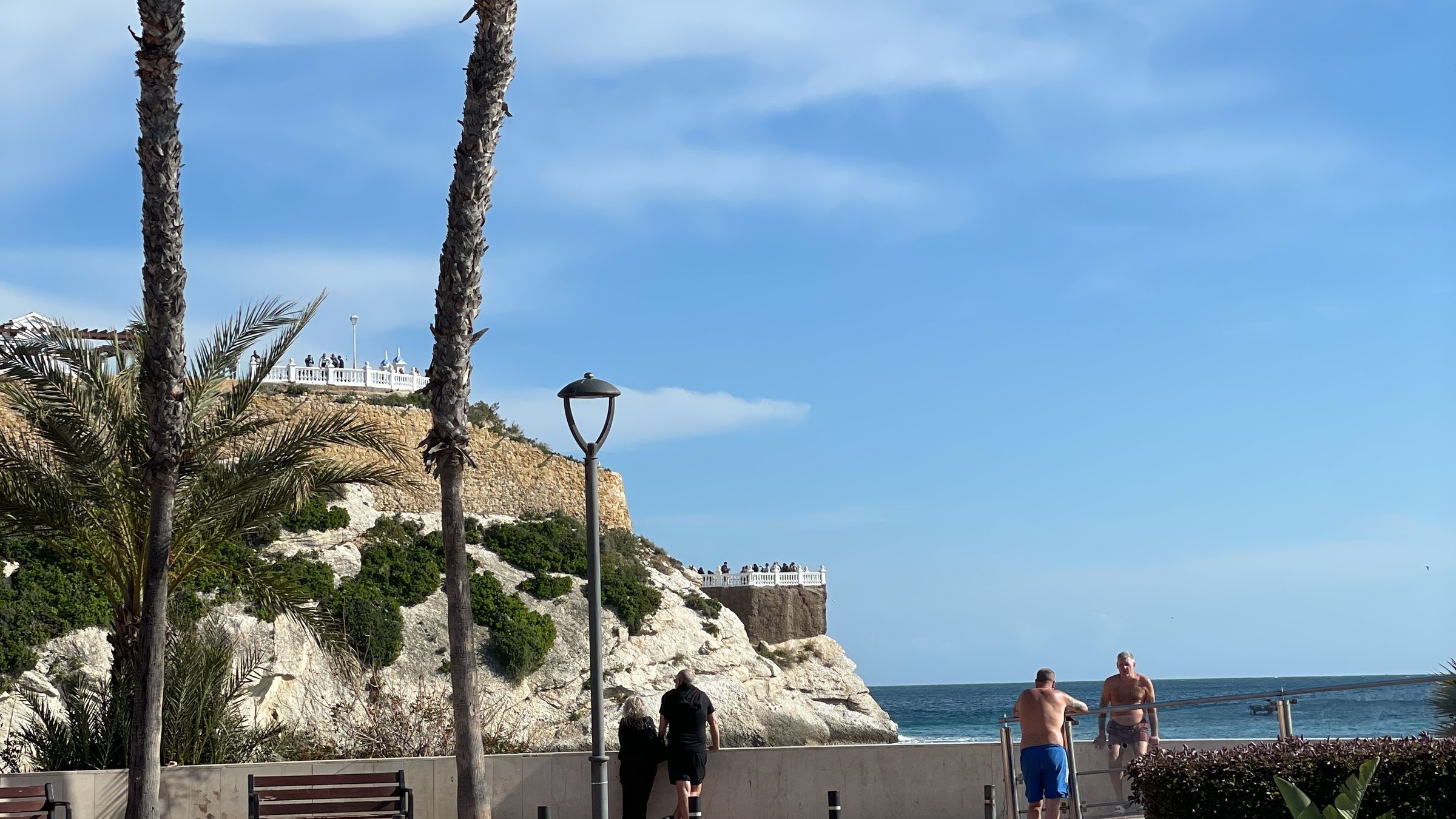
Salou sells itself on a long beach and a theme park, and both of those arrived recently. Passeig Jaume I is the counter-argument.
It runs for roughly a kilometre behind Platja de Llevant, wide and flat and shaded by palms old enough to have been planted with intent. Between the balconies of the 1970s stand a handful of houses built by families who came here for August a century before package holidays existed.
The shape of the promenade
Picture a very generous pavement — twenty-odd metres deep in places — sand on one side, a mixed wall of buildings on the other. Palms run down the middle in double file, set in beds rather than tubs, benches beneath them facing the water.
No traffic reaches the seaward side; cars are pushed back behind the buildings. That one decision is why the promenade works as a place rather than a route. Prams, bikes, mobility scooters, a slow tide of people in flip-flops carrying nothing: it absorbs all of it without ever feeling like a pavement.
Westward, it finishes at the Font Lluminosa and the foot of Carrer Carles Buïgas, where the resort keeps its noise. Eastward it narrows, climbs, and hands you to the coast path round Cap Salou.
Walk it at seven, not at two
Catalan gives the same word to the place and the activity. A passeig is a promenade, and a passeig is also the unhurried walk you take along one before dinner. Second meaning first, here.
Between seven and nine in the evening, once the sun is off the front and before the kitchens start serving, the resort empties onto this stretch and walks slowly from one end to the other and back. Nobody is going anywhere. Grandparents set the pace, children run ahead to the next bench, ice cream queues build.
In high summer, honestly, most of the people doing it are visitors. Out of season — March, or late October — you get the Catalan version, smaller and considerably better dressed.
A promenade is infrastructure for doing nothing in particular. Salou's is unusually good at that, which is not at all the same as saying it is beautiful.
At two in the afternoon in August the identical stretch is a hot, glaring, largely deserted run of paving. Judge it in the evening or do not judge it.
Why the Reus families built here
Reus in the nineteenth century was a serious commercial town — brandy, textiles, shipping agents, money — and for a stretch of it the second city of Catalonia by population. Salou was where Reus kept its port, and then, once the trains ran, where Reus went to swim. Ten kilometres, no effort.
So they built. From the 1880s onwards a line of summer houses went up facing the water: not palaces, generally, but confident two- and three-storey villas with gardens, verandas, tiled porches and roof detail that only makes sense if you are showing off slightly to a neighbour who made his money the same way.
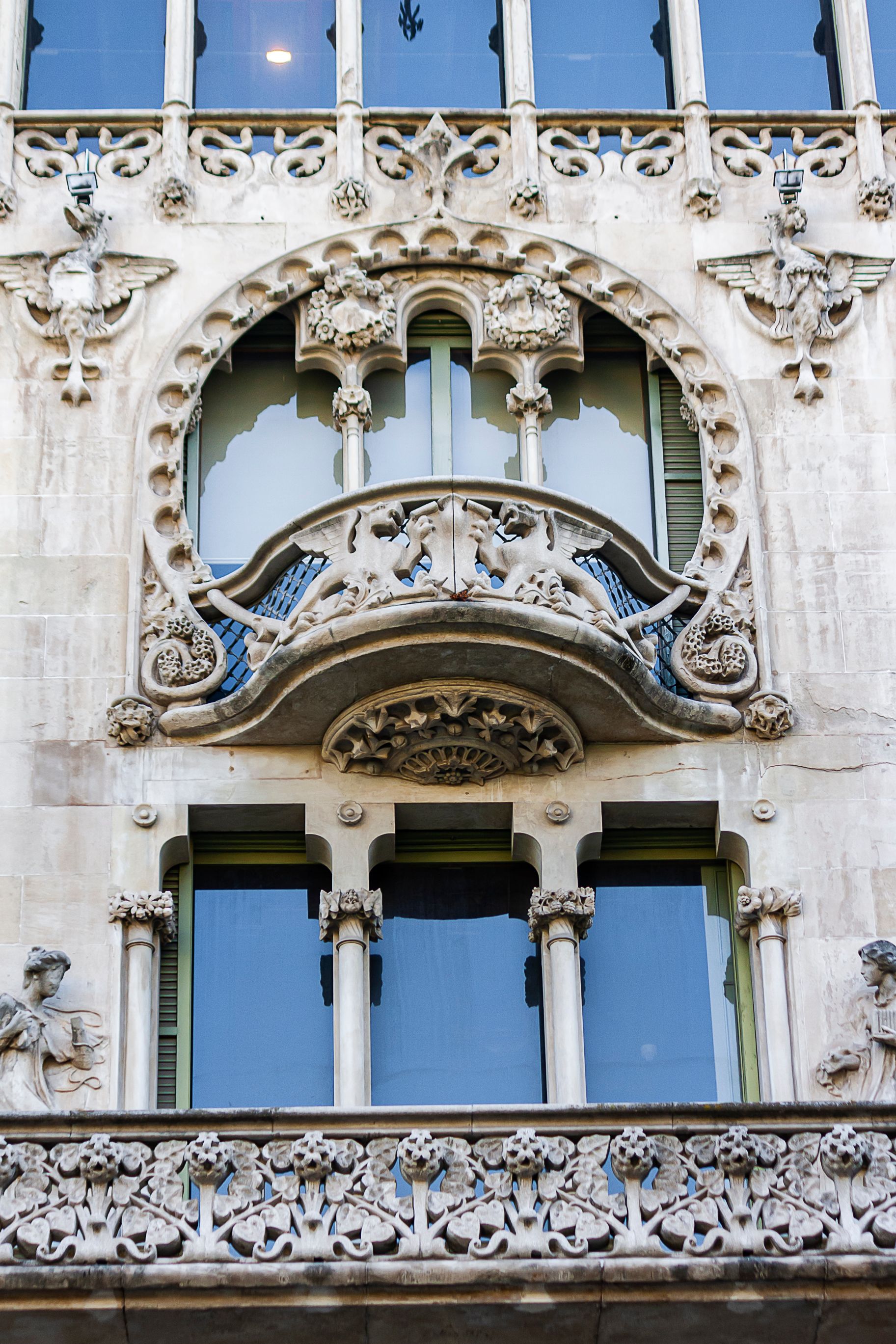
Two tastes overlap along the front. Earlier houses are Modernista — Catalan art nouveau, the movement that produced Gaudí — full of curved ironwork, flat ceramic colour and windows that decline to be rectangles. Later ones are Noucentista, the reaction that set in after about 1910: whiter, calmer, symmetrical, much less interested in surprising you. Both sit on the same pavement, sometimes next door.
Best known of the survivors is the Xalet Bonet, finished in 1918 to a design by Domènec Sugrañes i Gras, a Reus man who would later take charge of the Sagrada Família site after Gaudí's death. Worth sitting with, that: the architect who inherited Catalonia's most famous building project also did a seaside house here, because here is where his clients spent August.
A fountain, a king, and a very loud street
Closing the western end is the Font Lluminosa, the illuminated fountain. Its designer, Carles Buïgas, was the engineer behind the light-and-water fountain on Montjuïc, and he was still at the same trick down here in the early 1970s. Salou named the street running inland from it after him — which is how the town's loudest strip of bars came to be Carrer Carles Buïgas.
It performs after dark in season: coloured water on a timetable, a semicircle of families, phones up. Enjoyable rather than remarkable, and free — rarer here than it ought to be. Details in the note on Salou after dark.
At the far end, where the paving lifts toward the headland, a bronze Jaume I stands with his back to the town. In September 1229 the king gathered a fleet in this bay and sailed to take Mallorca. Salou's civic self-image comes off that one week — the promenade's name, the monument, and a good deal of pride in a resort short of history it can point at.
Six details that give the old houses away
Villas here do not announce themselves. Ground floors have mostly become shops, bars and estate agents, so the evidence starts above head height.
- A garden wall, or a surviving metre of one. Post-war blocks come straight out to the pavement; villas sat back behind railings and planting.
- Ceramic tile used flat and in strong colour — around a doorway, along a balcony edge, banding a chimney.
- Ironwork that curves. Balcony rails from 1905 bend; rails from 1972 run straight and get painted white.
- Windows in awkward shapes: arched, lobed, or paired under one larger arch.
- A turret, gable or corner tower serving no structural purpose whatsoever.
- Patterned render — esgrafiat, sgraffito, the top coat scratched away to show colour beneath. It weathers badly and survives in patches.
Do the villa-spotting walk before eleven in the morning. Light comes off the sea onto the facades, awnings are not yet down, and you can stop mid-pavement to look up without being walked into. At eight in the evening the same exercise is a contact sport.
Reading the front as a timeline
Walk it once with the buildings in mind rather than the sea, and the front turns into a section drawing of the last hundred and forty years. Almost everything that happened to Salou happened along this line.
| Period | What went up | How to spot it | What it says |
|---|---|---|---|
| Before 1880 | Fishermen's houses, port sheds | Almost nothing left on the front | A working port, not a resort |
| 1890s–1910 | Modernista summer villas | Tile, curved iron, garden walls | Reus money, arriving by train |
| 1910s–1930s | Noucentista villas | White render, symmetry, restraint | The same money, calmer taste |
| 1960s–1970s | Hotels and apartment towers | Eight to twelve floors of balconies | The charter flights had landed |
| 1990s onward | Repaving, palms, planting beds | The wide pavement you walk on | A town buying back its own front |
That last row has a date attached. Salou spent most of the twentieth century as a district of neighbouring Vila-seca, becoming a municipality in its own right only in 1989 — after which a town with its own budget started spending it on the front. Nearly everything underfoot postdates that split, which is why the paving is in better condition than most of what stands behind it.
This is not a preserved seafront
Be clear about what is here. A good number of the villas are gone, demolished in the boom years when a plot on this line was worth far more with twelve floors on it than with one family's summer house. Several survivors have been altered past the point of pleasure: ground floors knocked into retail units, verandas glazed in, gardens paved for parking, aluminium where there was timber.
What survives does not form a street. Houses stand one at a time, three or four floors of decorated stucco wedged between two slabs of 1972, come across the way you come across anything left over. No conservation quarter, no signed route, no stretch of frontage that hands you the nineteenth-century seafront whole.
Most surviving villas are in private or commercial hands and cannot be entered — the outside is what is on offer. One exception among the town's older buildings is Torre Vella, a sixteenth-century defensive tower a few streets inland, municipally owned and used for exhibitions. Check current opening with the town hall rather than assuming.
Take the promenade as fragments and it repays the hour. Arrive expecting a conserved historic front and the walk becomes an irritation: for every house that made it, several did not.
Which describes Salou generally: not a preserved place, a working one, with older things surviving inside it in pieces. How the fishing village became this is set out in the note on Salou before the resort; if the address matters, where to stay takes the front apart street by street. Listings come from the Salou tourist board.