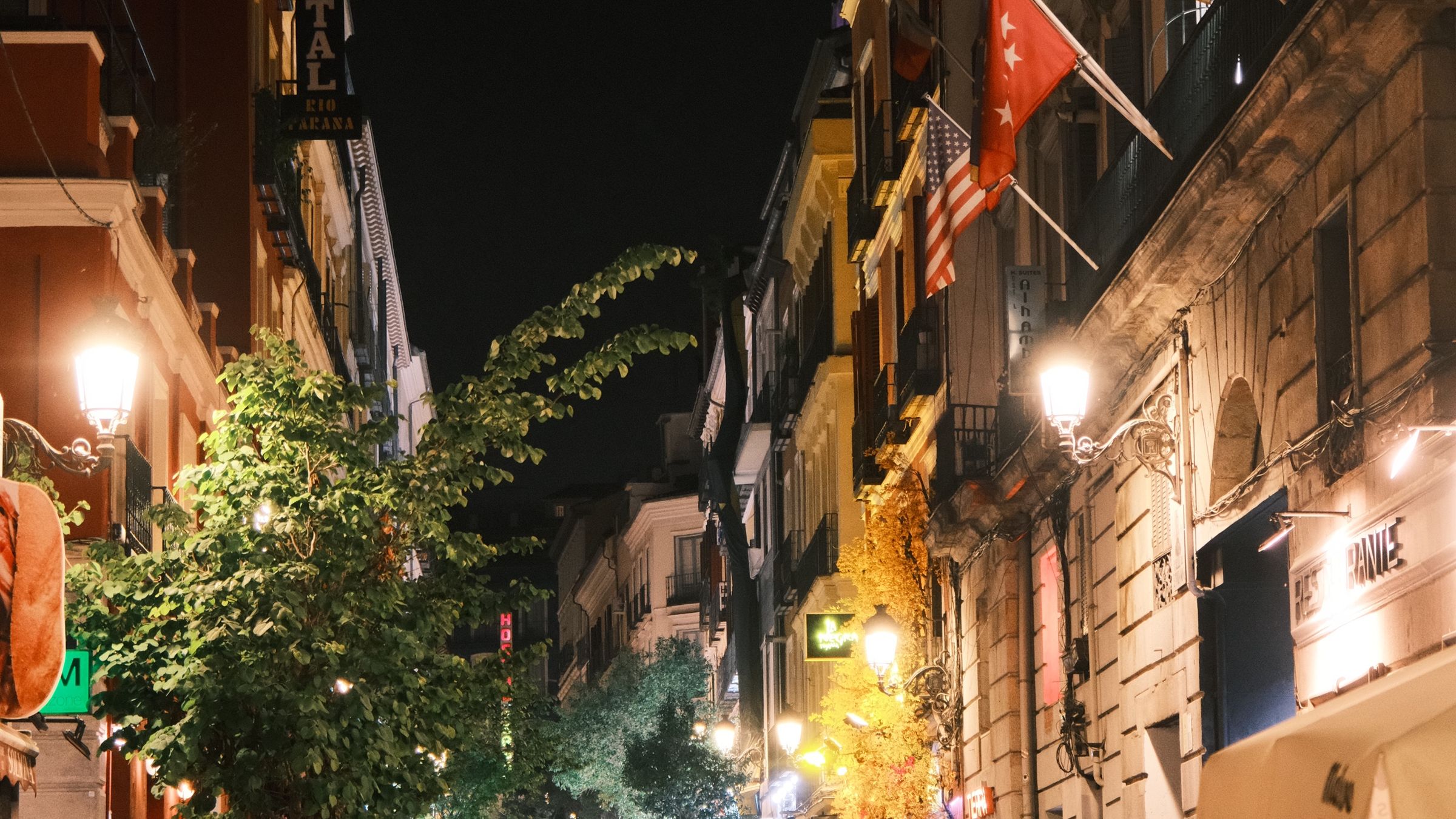
Salou's reputation after dark rests on one street, and that street is easy to find. Carrer Carles Buïgas leaves the seafront near the eastern end of the promenade and runs inland for roughly a kilometre. For most of that kilometre it is bars, clubs, open terraces and the people paid to fill them.
Almost everything ever written about nights in this resort is really about that one kilometre. What gets left out is what is happening three streets away at exactly the same hour: families out at eleven, a queue for ice cream, a few hundred people standing round a fountain waiting for the lights to change.
Both are true. They barely overlap.
The kilometre that made the reputation
Walk up from the sea and the change happens fast. Within a hundred metres the frontages stop being restaurants with tablecloths and start being open-fronted bars with the speakers pointed at the pavement. Signage switches to English. Boards advertise drinks by the litre. Screens show football to nobody in particular.
Promoters work both sides of the road, and they work them hard. Flyers, wristbands, two-for-one vouchers, a practised line about the club further up. Turning one down is an unremarkable transaction — a shake of the head, and they have already moved on to the group behind you — but there will be twenty of them between the bottom of the street and the top, and by the fifth the novelty has gone.
Doors open late here and stay open later. Bars fill from around eleven, the clubs behind them do their real trade from one in the morning, and in July and August a fair number are still going at five. Crowds skew young and skew heavily towards visitors rather than residents: British, Irish, Dutch, French, plus Spanish groups down from the cities for a weekend.
This is a hard-selling street and it does not pretend to be anything else. If being approached repeatedly by people trying to sell you drinks is your definition of a ruined evening, there is no need to walk up it to find out — you will have proved the point to yourself inside thirty seconds, with the whole kilometre still to walk back down.
The name on the street signs
Carles Buïgas was a Catalan engineer, born in 1898, who spent an entire career on a single problem: what water does when you light it properly. His best-known work is the illuminated fountain built for the 1929 exposition in Barcelona, which is still running. Decades later, by then an old man, he designed a fountain for Salou.
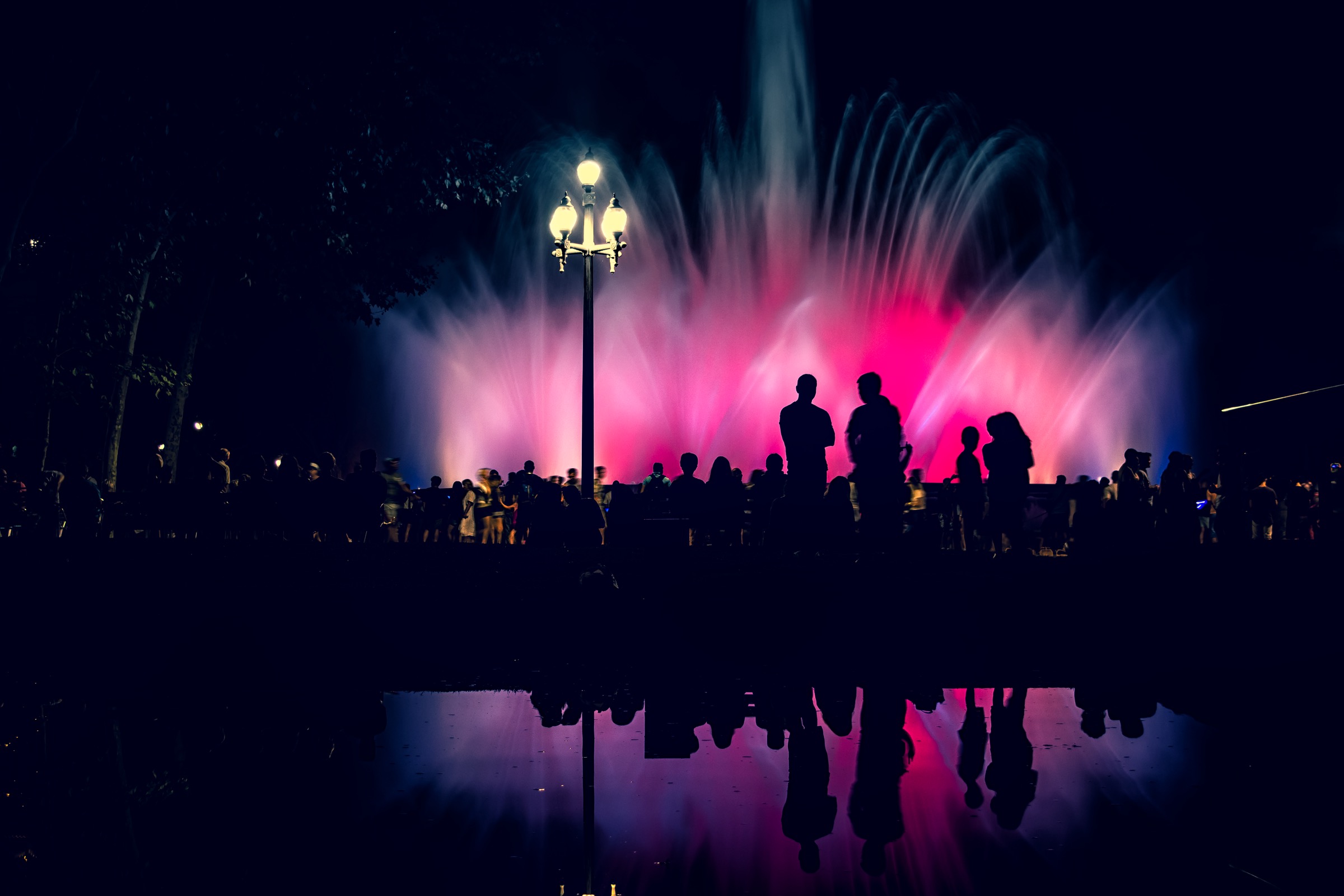
That fountain — the Font Lluminosa, the luminous fountain — sits at the foot of the promenade, a couple of minutes from the bottom of the street that carries his name. On a summer evening it pulls several hundred people who stand and watch coloured water rise and fall to music, and then wander off for gelato.
A street of late-night clubs is named after the man who built the family attraction at the end of it. Nobody planned that joke, and nobody in Salou appears to have noticed it.
Three streets away, a different night entirely
Passeig Jaume I is the other evening. Wide, palm-lined, running the length of the main beach, and busiest between nine and midnight when the heat has finally dropped and everyone comes out at once. Terraces on the landward side, a slow two-directional shuffle of people on the pavement, and children still awake at eleven because dinner started at ten and that is simply how the day is shaped here.
The fountain show runs on summer evenings, free, in several short sessions rather than one long one; the town publishes the season's timings and they shift year to year. It is unashamedly a light-and-water spectacle for an audience with young children in it, and on that basis it works. Further west the promenade thins out and the noise drops away towards the old port, which is a genuinely pleasant walk at eleven at night. More on that stretch and the streets behind it is in the note on Passeig Jaume I and the villas.
How far the sound actually carries
Here is the part the brochures skip. Loudness on the strip is not contained by the strip. Bass travels, and so do several hundred people walking home at four in the morning through streets built for daytime traffic. A hotel described as five minutes from the nightlife is, by definition, five minutes of sound away from it.
| Where you are sleeping | What you will hear | Earplugs |
|---|---|---|
| On Carrer Carles Buïgas | Music, doors, the street itself | Yes, and possibly not enough |
| Side streets within 100 m | Bass, plus people walking home | Yes |
| Passeig Jaume I, eastern end | A steady hum, occasional shouting | Probably |
| Ponent end and the old port | Very little | No |
| Cap Salou | Nothing at all | No |
A quiet holiday in Salou is entirely possible, but it needs more care at the booking stage than most people give it. Hotel names tell you nothing. Room position tells you everything. Ask which way the room faces, ask what is directly beneath the window, and read any listing that advertises itself as being at the heart of the nightlife as the warning it actually is. The geography of the quiet parts is set out in the note on where to stay.
Out of season, barely the same town
Most of Carrer Carles Buïgas closes for winter. Not quietens — closes, with metal shutters down and no lights behind them. From roughly November through to March a large proportion of the strip is shut, and the fountain show stops with it.
Under thirty thousand people live in Salou year-round, and in February that is precisely what it feels like: a small Catalan coastal town with a handful of bars serving the same faces, restaurants along the front doing steady local trade, and an enormous quantity of shuttered frontage in between. Some visitors find that bleak. Others book it deliberately.
April, May, late September and October are the useful middle ground. Enough of the strip is running that the town has an evening, without the scale of July. If the noise question matters to you at all, the shoulder months answer it better than any hotel choice can.
Getting back at four in the morning
Salou's saving grace at closing time is that it is flat and it is small. From the top of the strip to most central hotels is a fifteen-minute walk, well lit along the seafront and busy enough at that hour to feel unremarkable. Ranks sit near the promenade, though at the exact moment the clubs empty they empty too, and night hours carry supplements. Details of local transport are in the note on getting around.
Anyone staying out on Cap Salou or towards Vila-seca should settle the return journey before going out rather than after. Those addresses are a long walk and an unreliable taxi away at four in the morning, and that is a conversation better had while sober and in daylight.
Local ordinances on outdoor music and terrace hours do exist and are published by the town council; enforcement in high summer is a matter of local debate. Season programmes, including fountain timings, come from the Salou tourist board. Buïgas himself, for anyone curious about how a fountain engineer ended up lending his name to a nightclub strip, has a reasonably well-documented biography.