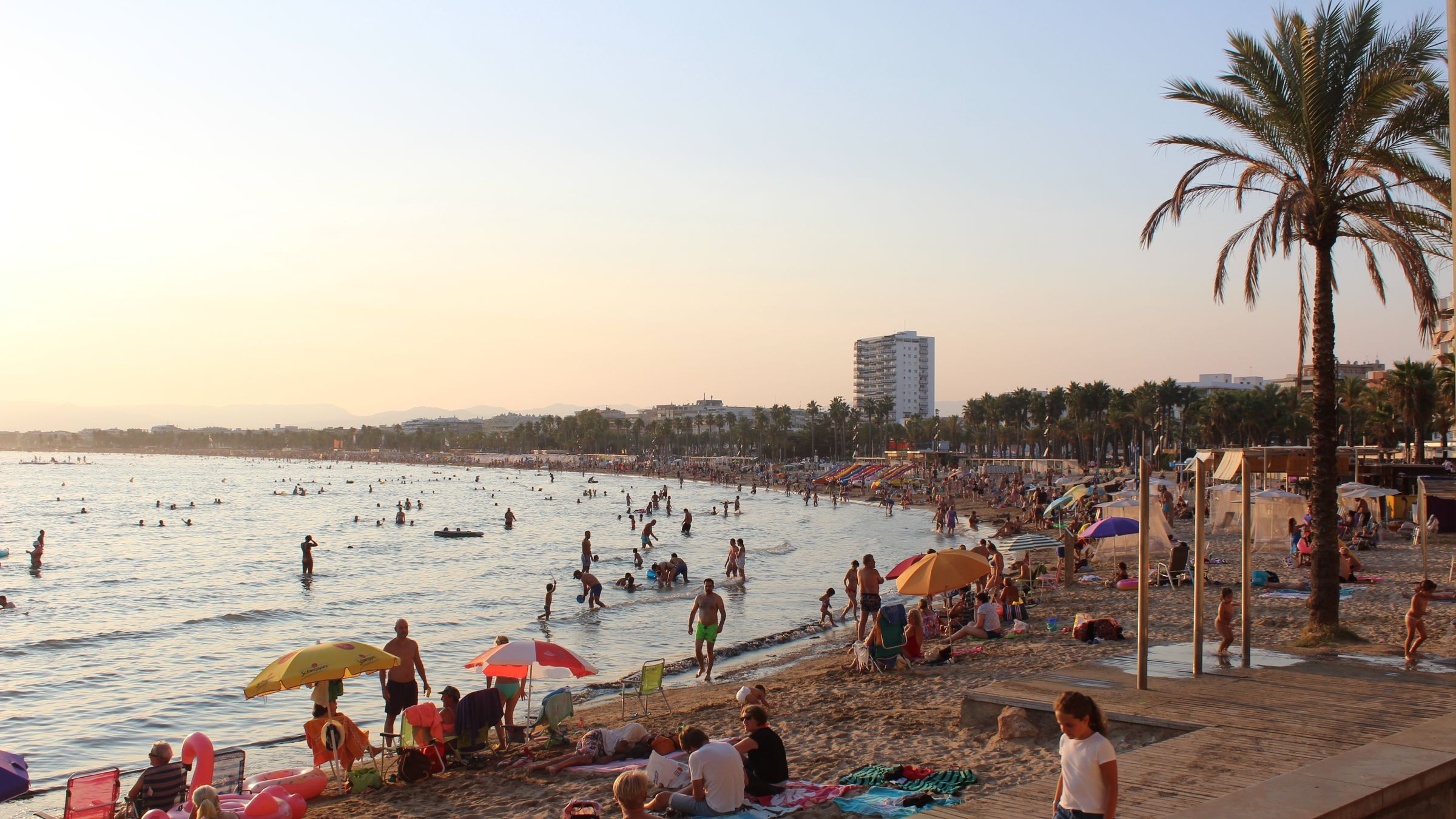
Most of what Salou is follows from this beach. Hotel blocks behind it, promenade in front of it, a small shipping and fishing town remade as a package resort inside one generation — all of it points at a single south-facing curve of sand where the sea takes an unusually long time to get deep.
Llevant means east. Salou's beach runs east from the middle of town, and almost everything about the way the resort functions assumes you are on it.
How big it actually is
A little over a kilometre of sand, in an arc shallow enough to take in at a glance from either end. From the Font Lluminosa — the illuminated fountain at the foot of Carrer Carles Buïgas — it curves towards the low wooded rise of Cap Salou, which closes the far side of the bay. End to end is twenty minutes at a stroll, longer in August, when crossing the towels requires something closer to navigation.
Sand here is fine and pale, nearer biscuit than gold, raked by tractor most mornings through the season. Width counts as much as length: sixty-odd metres of dry sand across the middle, enough for the sunbed concession, the traffic walking down to swim and the towel population to coexist without much friction.
Water that takes its time
This is the part that made the town.
Out here the seabed shelves so gradually that an adult can wade thirty or forty metres and still be standing comfortably, with a child on each hand. No drop-off, no shingle step, no current worth the name, and on an ordinary summer morning a sea flat enough to see your feet through.
So the beach does much of its own supervising. Parents who spend every other holiday standing chest-deep with their arms out spend this one sitting on the sand watching, and that single piece of underwater geology explains more about who books Salou than any brochure.
Shallow water sends its bill in late August, when the sea is bathwater-warm and, in the fullest weeks, not especially fresh. A day or two after any real blow it turns cloudy and stays that way. Anyone wanting depth and clarity walks round the headland to the coves, where the bottom drops away within a few strokes. For a shorter, scrappier, more local stretch, the beach past the old port does a different job.
Behind the sand, a promenade
Passeig Jaume I runs the full length of Llevant: a broad tiled walkway, double rows of palms, benches turned to face the water, and planting the town keeps in better order than a resort of this kind strictly needs to.
What stands behind the palms is a compressed history of the place. A handful of summer villas survive from the early twentieth century, when families from Reus and Tarragona built along here for the sea air — the Xalet Bonet is the one most people photograph without knowing what it is. Between them stand the hotel blocks of the 1960s and 70s, put up fast. Passeig Jaume I has its own note, because the villas repay a slow walk.
Two practical things follow. Passeig Jaume I is the shaded route along the beach, which has almost no shade of its own — on the sand you get whatever you rent or carry. And it is where the town moves in the evening, from about seven, when the sand empties and the paseo starts.
What the beach provides
Llevant is a serviced beach, run as such, and in season the list is long:
- Hamaques — sunbeds, hired by the day with a parasol, set out in rows along the front of the sand
- Freshwater showers and foot taps along the back, public toilets at the main access points
- Lifeguards through the summer months, green, yellow and red flags flown from the towers
- Accessible bathing points: matting and ramps down onto the sand, amphibious chairs, and assisted bathing at set hours in high season
- Beach bars, pedalos, kayaks and a couple of volleyball nets in the wider sections
Salou takes its Blue Flag seriously — Llevant has held one in most recent years, and the flags fly where nobody can miss them. Beaches here are described by the municipal tourist board, the award criteria by the Blue Flag programme. As a signal it is fair on water quality and facilities, and silent on crowding, which on Llevant in August is the only question that matters.
All of the above is seasonal. Outside roughly mid-June to mid-September the sunbed rows come in, lifeguard towers stand unmanned, some showers are shut off and the beach bars close. Sand stays open, and out of season the beach is arguably at its best — swimming then is on your own account.
Walk east and it thins
Llevant is not one beach so much as three moods laid end to end, and choosing between them costs nothing but a few minutes of walking.
At the town end, by the fountain and the mouth of Carrer Carles Buïgas, density is highest. Everything is within thirty seconds — bars, shops, ice cream, the bus stop — and everything is loud. Sunbed rows run deepest here, pedalos and inflatables sit moored offshore, noise from the promenade carries.
Midway along, it is widest and most straightforwardly family-shaped: ranks of parasols, small children in the shallows, a steady traffic of parents walking to the showers. Sand runs deep enough front to back that the crowd spreads instead of stacking.
Towards the far end, where the beach narrows before the rocks, there are fewer services and noticeably fewer people. More Catalan spoken, more older couples with folding chairs, more early swimmers doing lengths parallel to the shore. Nothing differs about the water. Everything differs about the atmosphere.
Six hundred metres of walking is the difference between a bad morning on Llevant in August and a decent one.
One July day, hour by hour
High-season Llevant runs to a timetable that nobody publishes but everyone follows.
| Hour | Town end | Far end |
|---|---|---|
| 07.00 | Tractors raking, runners, flat sea | Swimmers doing lengths |
| 09.30 | Sunbed rows laid out and filling | First families, plenty of space |
| 11.30 | Full; towel space genuinely scarce | Busy but walkable |
| 14.00 | Thins as people go to eat; hottest hour | Half empty, breeze building |
| 17.00 | Second wave, families back in the water | Steady, softer light |
| 19.30 | Sand emptying, promenade filling | All but empty |
| After dark | Walkers, no lifeguards, sunbeds stacked | Dark and quiet |
That afternoon lull is real and worth using. A sea breeze — the marinada — usually gets up after two, taking the edge off the heat and roughening the water just enough to entertain children bored of a flat sea.
August, said plainly
From about the third week of July until the first days of September, the town end is packed in the literal sense. By half past ten on a clear morning no unclaimed rectangle of sand large enough for a towel remains within reach of the water, and by midday people are laying out in the walking lanes and along the back by the promenade wall — hot, dusty and a long way from the sea.
Hamaca rows compound it, taking the best of the sand — the front strip nearest the water, blocked out and laid before anybody arrives. What is left for towels sits behind them. Choices on an August morning are therefore narrower than they look: pay for a lounger, walk east until the crowd gives out, or turn up before nine.
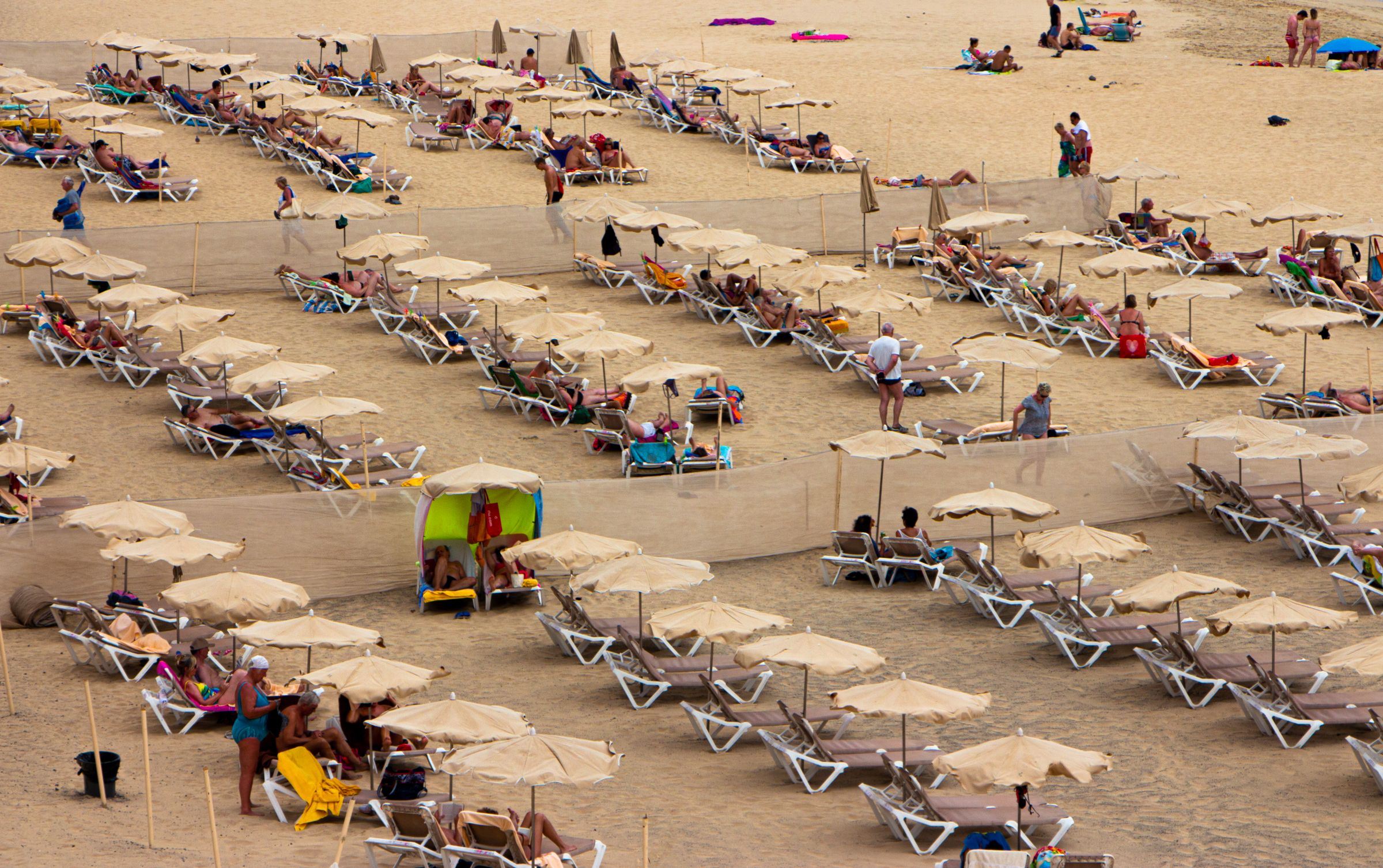
Three responses work, in ascending order of effort. Walk fifteen minutes east and accept fewer bars. Come down at eight, plant a parasol and go back for breakfast, which is what half the town does. Or shift the trip to June or September, when the water is as warm, the services still run and the sand is not a competition — see when to come.
None of this makes Llevant a bad beach. It makes it a busy one, which is a different complaint and a predictable result of a mass-market resort doing what it was built to do. Sand is clean, water is safe, services beat most of this coast, and for six or seven weeks a year there are too many people on it. Beach conditions and flag status are posted by the town hall; the wider coastline is covered by the Costa Daurada tourist authority.