Almost nobody comes to Salou for its history, and the town does little to argue otherwise. Hotels, a promenade, a theme park up the road — that is the offer, honestly made.
Underneath it sits a past stranger than a resort this size has any right to. A royal fleet left this bay to take Mallorca. A rich town nine kilometres inland shipped its brandy out through here for two centuries. A tower raised against corsairs in 1530 still stands in a garden four streets back from the sand, and most visitors walk straight past the sign for it.
None of which is a reason to book a holiday. Call it a reason to give the place half a morning.
Why anyone stopped here in the first place
Geography, and nothing more complicated. Cap Salou pushes south into the sea and breaks the weather coming down the coast; behind the headland the shore falls back into a shallow curve with decent holding ground and no need for a breakwater. Ships could simply lie there, which on a coast otherwise short of shelter was worth something.
Iberian and Roman material has turned up around the bay, and the site is traditionally identified with Salauris, a name that survives in classical geography rather than on anything excavated and labelled. Documentary Salou begins more firmly in 1194, with a charter of settlement granted by Alfons el Cast to Ximeno d'Artusella. From then it is continuously on the record — small, thinly populated, useful.
A caution about the ancient part. Salauris appears in classical sources, and the identification with this bay is long-standing, plausible and unproven. Panels around town state it flatly. This almanac would not.
September 1229
On the fifth of September 1229, the fleet of Jaume I of Aragon sailed from this bay for Mallorca.
Ships had gathered at Cambrils and Tarragona too, and the argument over how many left from where is old and unresolved. Not in doubt: the king chose this anchorage to assemble his expedition, and the departure is dated from Salou. Landfall came at Santa Ponça. Madina Mayurqa fell at the end of December, the Balearics passed to the Crown of Aragon, and a Catalan-Aragonese Mediterranean began that would eventually reach Sicily and Athens.
For a town this size that is an extraordinary thing to carry, and Salou knows it. Its seafront is Passeig Jaume I. At the eastern end stands the monument: a stone king, a carved ship, and a horse's head in gold leaf, by the architect Salvador Ripoll with the sculptor Lluís Maria Saumells, unveiled in November 1965.
That date matters. Salou raised its monument to 1229 in the same handful of years it was demolishing nearly everything else that was old. Commemoration and clearance ran side by side.
A port that belonged to a town nine kilometres inland
For most of the eighteenth and nineteenth centuries Salou was not a town with a port. Reus was the town. Salou was where Reus touched the sea.
Reus in that period was seriously rich — among the largest places in Catalonia, and a pricing centre for the European trade in aiguardent, the grape brandy distilled across this hinterland. Barrels came down to the shore by cart, along with silk woven in Reus, and went out to northern Europe. Salou's wharf handled somebody else's prosperity and kept almost none of it.
Jurisdiction followed the money badly. Rights over Salou belonged to the archbishopric of Tarragona until 1673, when they passed to Vila-seca — an inland village with no stake in the trade — handing the merchants of Reus a grievance they nursed for two centuries. They had a remedy in mind: cut a navigable canal from Reus to the sea at Salou and hold the advantage while Tarragona improved its harbour. Surveyed, argued over, never dug. Tarragona won.
Officialdom offered no help. A customs house went up in 1820; a decree that November suspended the port's operations. Salou spent much of the nineteenth century being almost a port.
Torre Vella
The best surviving thing in Salou sits ten minutes on foot back from the beach, and hardly anyone bothers with it.
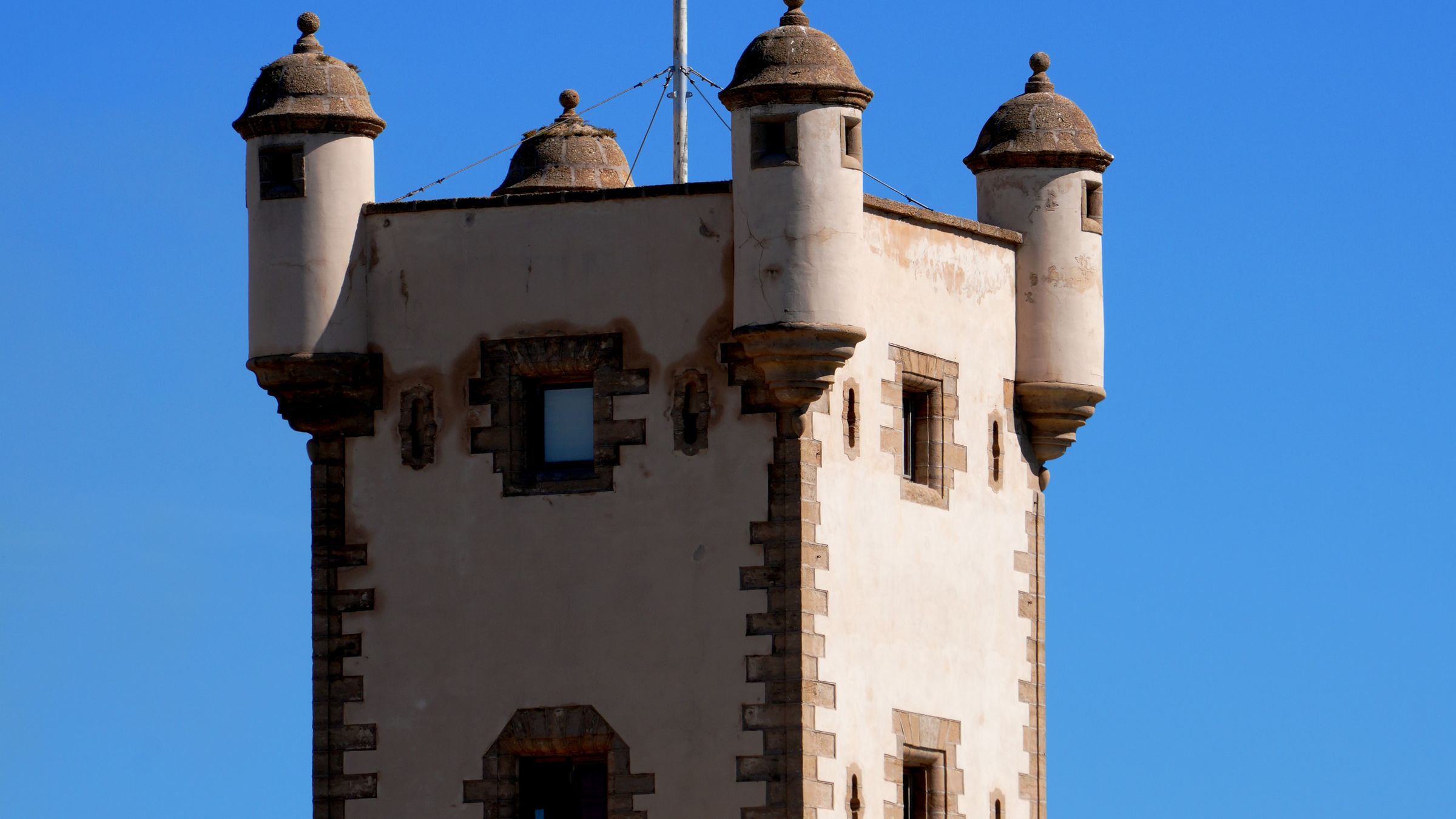
Pere de Cardona, Archbishop of Tarragona, ordered it built in 1530. Corsairs were the reason. Raiding out of North Africa was a working hazard along this coast for centuries, not a costume-drama detail, and a chain of towers went up on the shore to give warning and somewhere to retreat into. Salou's is square, three floors, with a stone spiral stair inside and Cardona's arms cut into the façade.
Today it is a municipal exhibition space, holding a permanent collection of contemporary enamel work and a rotating programme of shows, in a walled garden cooler and quieter than anything near the promenade.
Opening hours are seasonal and shorter than you expect, and the tower shuts between exhibitions. If the door is closed the gardens usually are not. Best kept for three in the afternoon in August, when the beach has become unbearable and you want shade and quiet.
What the railway changed
A lighthouse went up on the headland in 1858. Seven years later the station opened, on the coastal line between Valencia and Barcelona — a line that served Salou and missed Reus, which is why Reus spent two decades lobbying for a connection of its own. It arrived in 1887: the carrilet, a light railway of about nine kilometres down to the sea.
By then the point of the exercise had gone. Freight moved by rail, Tarragona's harbour took the deep-water business, and Salou's relationship with the sea contracted to fishing and the coasting trade.
Trains brought something else. Families from Reus started coming down for the summer, and through the 1920s a run of modernista villas appeared along the front — still the only architecture in Salou anyone photographs for its own sake. A handful survive; most do not. They get their own entry in the note on the passeig.
Twenty years, and a different town
Then the charter flights began landing at Reus, and this coast was rebuilt at speed.
Between roughly 1960 and 1980 Salou acquired the shape it has now: a wall of accommodation behind the beach, a street grid laid for cars and holidaymakers rather than fishermen, and a population that multiplies several times over between May and September. Few Spanish coastal towns escaped that decade. Salou did not especially try.
One late correction is worth knowing. On 30 October 1989, after a decade of campaigning and a Supreme Court ruling, Salou separated from Vila-seca and became a municipality in its own right — undoing the arrangement imposed on it in 1673. PortAventura opened six years later, on land at the town's back, and the season stopped being purely a matter of the beach.
| Year | What happened |
|---|---|
| 1194 | Charter of settlement granted by Alfons el Cast |
| 1229 | Jaume I's fleet sails for Mallorca on 5 September |
| 1530 | Torre Vella built against corsair raiding |
| 1673 | Rights pass from the archbishopric to Vila-seca |
| 1858 | Lighthouse begins working on the headland |
| 1887 | The carrilet links Reus to the shore |
| 1920s | Modernista summer villas along the seafront |
| 1960s | Package tourism rewrites the town |
| 1989 | Salou becomes an independent municipality |
Fragments, and what they add up to
Not much, and anyone arriving in search of a historic core will be disappointed. Salou has no old quarter. The boom did not build around the old town — it built over it, and what came through is a short list of unconnected objects.
- Torre Vella and its gardens, the one substantial pre-modern building left standing
- Santa Maria del Mar, the parish church, consecrated in 1776
- A thin remainder of modernista villas along Passeig Jaume I
- The outline of the old port at the western end of the bay
- The lighthouse out on Cap Salou, in service since 1858
Nothing on that list is more than a quarter of an hour from anything else, and the whole of it fits inside a morning. Which is the honest position: Salou has a genuine history and almost none of its fabric. The 1229 fleet is a fact rather than a quarter you can wander around. Anyone wanting medieval streets should get on a train; anyone willing to take history in fragments will find these ones unexpectedly good.
To take them in order, start at the monument and work west along the passeig and its surviving villas, finish where the fishing boats used to sit at the Ponent end of the bay, and leave the headland for another day — Cap Salou is a separate walk. Municipal history is published by the town hall, visitor information by the tourist board, and the 1229 campaign by the encyclopaedia entry on Jaume I of Aragon.