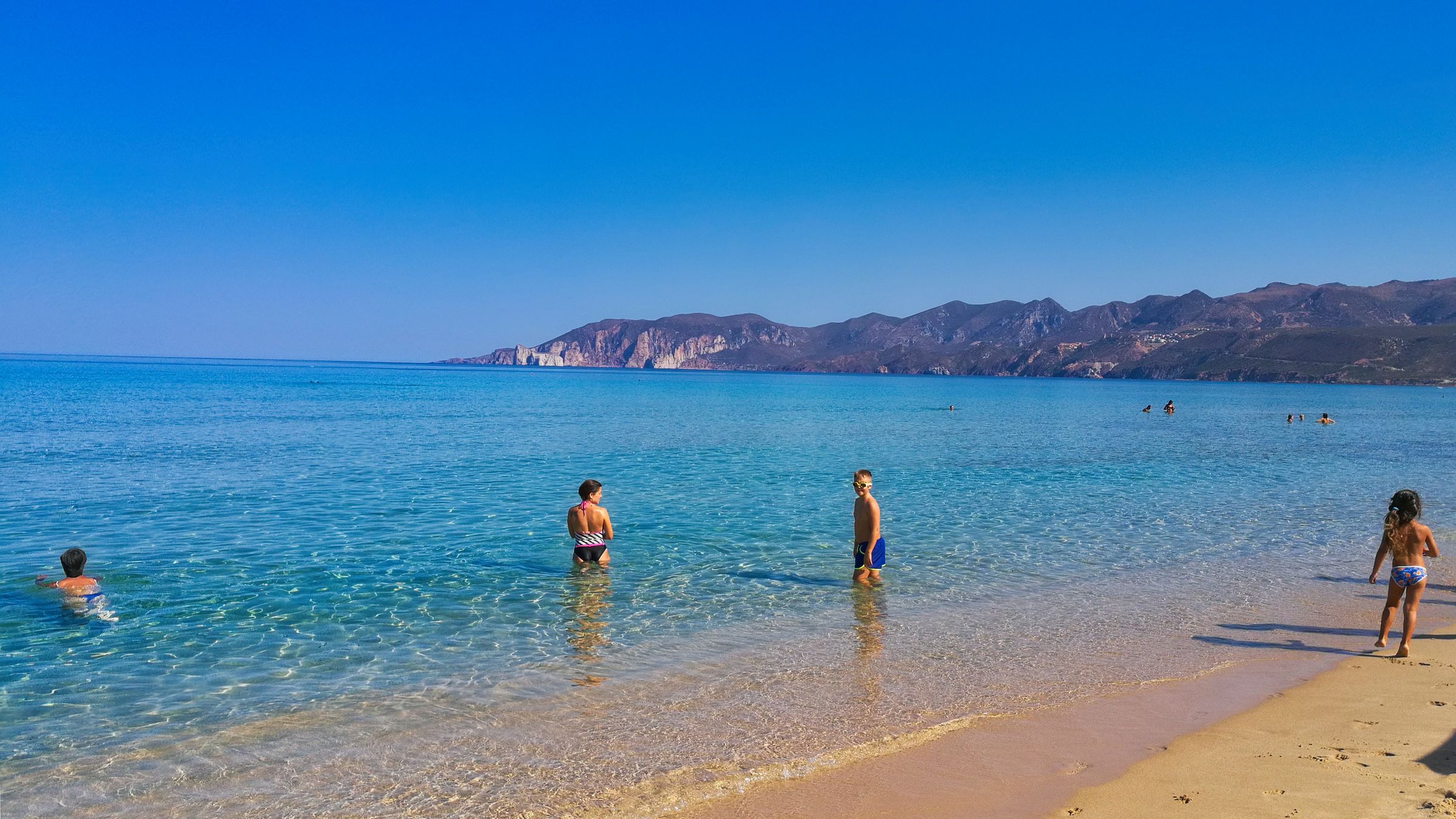
Salou earns its living from package weeks, theme-park tickets and a nightlife strip, and advertises all three at volume. The thing it does best is never mentioned: this is one of the easiest places on the Catalan coast to spend a week with a three-year-old.
That is not a compliment about charm. Charm is thin on the ground here. It is a statement about gradients, sand, opening hours and how far a pushchair has to be pushed.
What the beach actually gets right
Begin with the sand, because everything else follows from it. Costa Daurada translates as golden coast, and for once a tourist-board name is a plain description: fine, pale, deep sand, without any of the shingle that turns so much of the Mediterranean into an obstacle course in bare feet.
What matters more is the angle of the seabed. It shelves so gradually that a small child can wade thirty or forty metres out and still be standing in water at hip height, and on a calm morning the sea barely moves. Anyone who has spent a holiday knee-deep in a dumping shorebreak with one hand permanently on a toddler will understand what that is worth.
Platja de Llevant is where it shows most clearly: roughly a kilometre of sand, lifeguarded in season, promenade running the full length behind. Volume is the trade-off. Through August the middle stretch is wall-to-wall parasols, and having space by eleven means arriving by nine. More room towards the eastern end, where the beach meets the headland.
Not all of Salou behaves this way. Round Cap Salou the coves are prettier, quieter and considerably harder work, reached by steps and dirt paths that a pushchair will fight you over from one end to the other. Worth a morning without the chair. Not worth a daily argument.
Flat, and what that buys you
Passeig Jaume I runs the whole length of Llevant — wide, palm-lined, level. No steps anywhere in it. Across a week with a pushchair, that single dull fact does more work than any facility listed in any brochure.
In practice you leave the room after breakfast and stop thinking about the route. Promenade, down onto the sand by one of the timber walkways laid out for the season, back up, along to a café, along to a play area, home. Nothing gets carried up anything.
- Kerbs are dropped at most seafront crossings, and the promenade itself has none at all.
- Timber walkways run several metres out across the sand in season, so the chair parks close to where you sit rather than at the top of the beach.
- Supermarkets, chemists and beach-tat shops sit one or two streets back, so a forgotten sun hat is a five-minute problem rather than a lost morning.
Behind the front the town climbs, gently but steadily, and several streets running inland are steeper than they look from below. Nothing that needs planning around — just the difference between a walk and a shove, and worth knowing before booking a room four blocks up.
Font Lluminosa, after dark
Where Passeig Jaume I ends and Carrer Carles Buïgas begins, a large illuminated fountain sits at the junction. It performs most evenings in season: jets rising and falling, colour shifting through the water, music underneath. Carles Buïgas, who designed it, also built the fountains on Montjuïc, and the resemblance is unmistakable.
Adults tend to find it dated. Children under about seven find it close to hypnotic.
This is not a trivial observation. Somewhere between eight and ten a young family runs out of daylight without running out of child, and the Font Lluminosa absorbs that gap with unusual reliability: forty minutes of standing still, a wall to sit on, ice cream within thirty metres, and a show that repeats, so a four-year-old who missed the start has missed nothing.
Most families work the fountain out by their second evening and then go every evening after. It is as close as this resort gets to a bedtime ritual.
Playgrounds, and where they are
Play areas sit at intervals along and just behind the seafront. Small, municipal, unremarkable — useful precisely because they are frequent rather than good. None is a destination. What they do is let an afternoon walk be broken wherever it needs breaking, which with a four-year-old is the whole requirement.
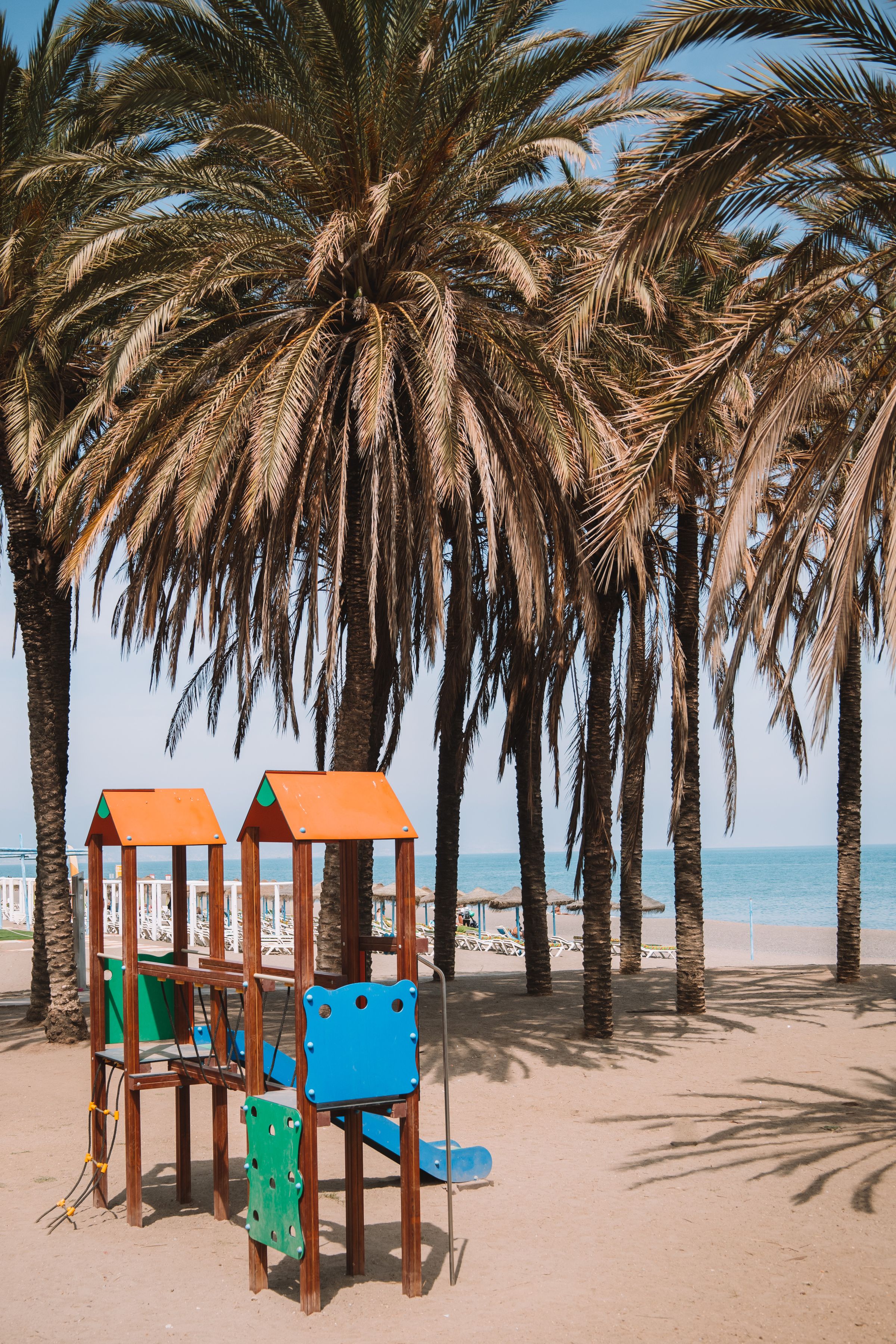
Something larger means going inland. Parc de la Ciutat, a few minutes back from the beach, has grass, water and actual trees — the last being what the seafront most conspicuously lacks between noon and five.
Shaping the day around the heat
Now the honest part. Midday in July or August is simply not usable with small children here. Sun directly overhead, sand too hot to cross barefoot, shade limited to palms — the least useful trees ever planted for the purpose. Temperatures sit around thirty degrees with coastal humidity behind them, and a two-year-old will be finished long before the adults are.
So the day splits in two. Split it deliberately rather than discovering the schedule by attrition on the third afternoon.
| Hours | Where | Why |
|---|---|---|
| 08:00–12:30 | Beach | Sea flat, sand still cool, space for a towel |
| 12:30–13:30 | Lunch, indoors | Air conditioning matters more than the menu |
| 13:30–16:30 | Room | Nap, or failing that, dark and cool |
| 16:30–19:30 | Beach or pool | Sun off the worst of it; water at its warmest |
| 19:30–22:00 | Front, fountain, dinner | Warm, busy, easy — the resort at its best |
Hire a parasol and two loungers on the first morning and pay for the whole stay at once: cheaper by the day, and it removes a queue from every morning after. Shade on Llevant is a purchased commodity, not a natural feature. Anyone travelling with a baby should also bring a pop-up beach tent — a parasol alone will not do at two in the afternoon.
Feeding children at six o'clock
Spain eats late. Salou, built for northern Europeans, largely does not, and for once the flattening of local habit works in a visitor's favour. Kitchens along the front serve dinner from about six, hours before any restaurant in a Catalan town would take the idea seriously, and an early table is treated as normal.
Quality varies enormously, and correlates almost perfectly with distance from the sea. Places on the promenade trade on the view and a children's menu of nuggets and chips; two or three streets back the cooking improves and the bill falls. Either way, high chairs are universal, noise goes unremarked, and a pushchair parked at a terrace table draws no comment.
Choose the room before you choose anything else
Here is the decision that will shape the week, and it has nothing to do with the beach.
Carrer Carles Buïgas — the street running inland from the fountain — is Salou's nightlife strip. Bars, clubs, and the traffic between them, loud until three or four in the morning through July and August. It begins at the same fountain your children will want to visit every evening. Salou's family end and its drinking end are not separate districts; they are the same few hundred metres at different hours.
A room on Carrer Carles Buïgas, or in the blocks immediately behind it, will be noisy until the small hours in high season regardless of what any listing claims about double glazing. Ask which way the room faces and get the answer in writing before paying. This is the most consequential choice of the holiday, and it gets made months before anyone arrives.
Otherwise the rule is walking distance, and Salou rewards it more than most resorts do. Anywhere along the eastern half of Passeig Jaume I, or in the quieter blocks behind Platja de Ponent towards the old port, puts sand, a supermarket, a play area and dinner inside ten minutes on foot. Ponent is the shorter and calmer of the two beaches, and repeat families often move to that side — the note on where to stay takes the trade-offs street by street. A hire car earns nothing here beyond a parking problem, PortAventura included, since buses run out to the park all day.
None of this makes Salou a discovery. It is a mass-market resort doing the same job it has done for fifty years, and it works for families with very young children largely by accident: flat ground, shallow water, early kitchens, and a fountain somebody once put at the end of the promenade. Beach and season information is published by the Salou tourist board, municipal detail — parks, lifeguard dates, accessibility points on the sand — by the town hall.